
TypeSafe AI Jev is a hosted model for making structured semantic decisions inside software. Give it some state and a set of typed questions, and it returns choices, scores, or yes/no probabilities that ordinary code can use directly. It does not generate prose, write code, or run an autonomous workflow.
That narrow interface is the point. TypeSafe is betting that many production AI calls do not need another paragraph of generated text. They need an answer to a bounded question such as: Which queue should receive this ticket? Does this document contradict the request? How severe is this exception? Is the model uncertain enough to involve a person?
Jev launched in early access on September 15, 2026 as TypeSafe's first "System One Model." The company also announced a $40 million seed round led by DCVC. This TypeSafe AI review separates the useful product idea from the claims that still need broader evidence.
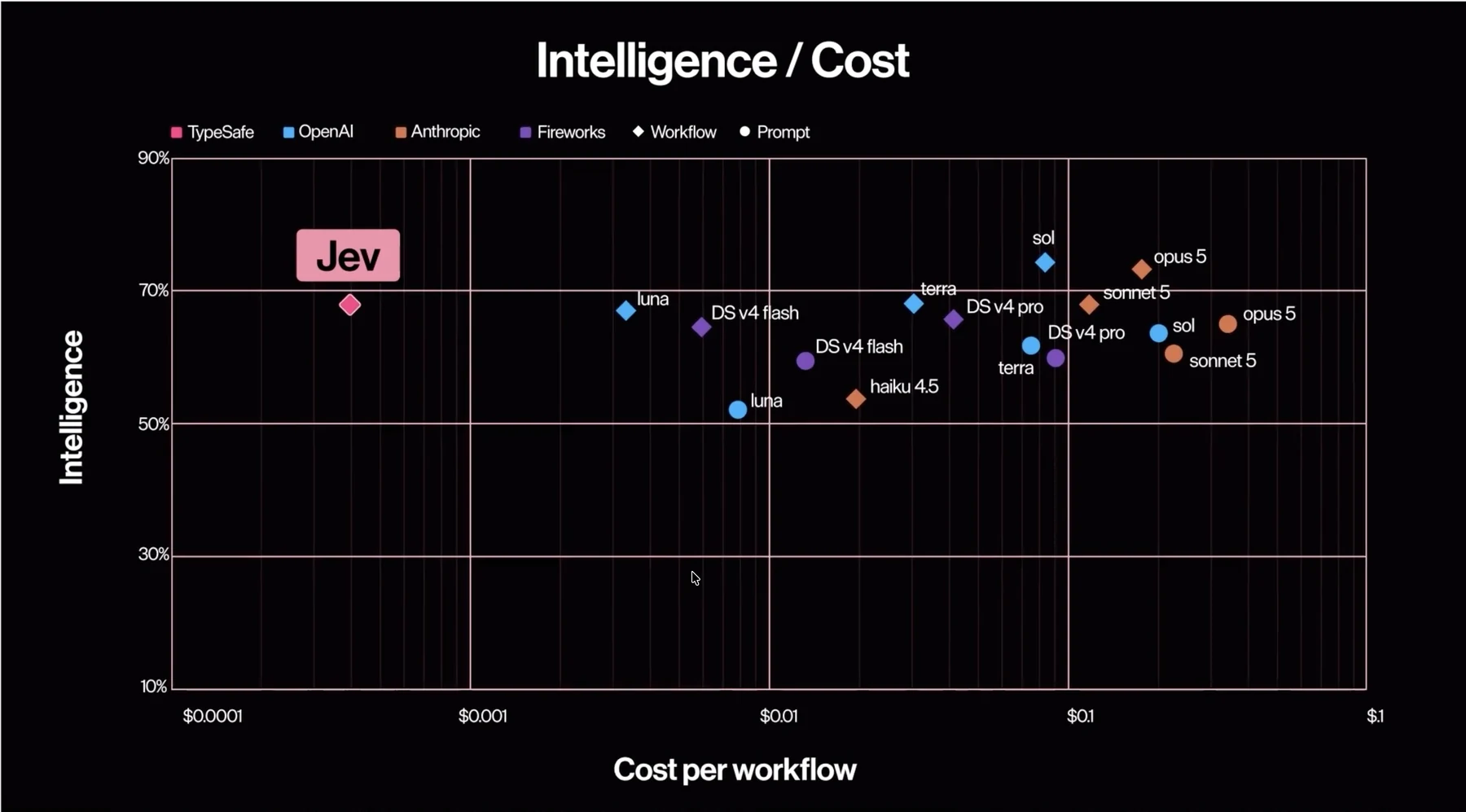
The chart above is a cropped frame from founder Diogo Almeida's Jev launch video on X. It shows TypeSafe's own workflow comparison; the benchmark limits are examined below.
TypeSafe AI Jev review: the quick verdict
Jev has a credible interface for one specific class of AI work: repeated judgments where the possible answers can be defined before the request. Its strongest qualities are typed results, probability distributions, parallel questions, and a low published price. Its largest unanswered questions concern accuracy on independent real-world datasets, calibration after data shifts, service limits, and how the underlying model works.
| If you need to... | Jev's fit |
|---|---|
| Classify, score, route, rank, or screen many items | Strong candidate for a measured trial |
| Inspect uncertainty before code takes an action | Strong candidate, provided you validate calibration |
| Generate prose, explanations, code, or open-ended plans | Poor fit; use a generative model |
| Make a consequential decision with no fallback | Poor deployment design for any probabilistic model |
| Replace a stable rule or SQL condition | Usually unnecessary; keep exact logic in code |
Our recommendation is to test Jev in shadow mode against historical human decisions. Measure accuracy and coverage at several confidence thresholds before allowing it to affect a live workflow.
How this review was researched
We reviewed TypeSafe's launch material, public documentation, API examples, evaluation harness, launch-day community experiments, and the independent test published by Every. We did not have a Jev early-access key and did not make a live TypeSafe API call. The code below follows the official SDK shape, while performance and accuracy figures remain attributed to the organizations that reported them.
What is TypeSafe AI Jev?
TypeSafe describes Jev as a model that accepts unstructured or structured state and returns typed probabilistic decisions. The current API exposes three question types:
| Primitive | Question it answers | Returned value |
|---|---|---|
Choice | Which predefined option fits best? | Selected option, probability distribution, confidence |
Score | Where does this fall on an ordered scale? | Numeric score, level distribution, confidence |
Noul | How likely is this statement to be true? | Probability from 0 to 1 |
A single request can contain several questions. Each question sees the same state, but TypeSafe says the model evaluates them independently and produces the outputs in parallel. The official primitives documentation recommends asking one focused judgment per question and combining the answers in code.
Jev at a glance
| Detail | Public information at launch |
|---|---|
| Availability | Hosted API in early access |
| API endpoint | POST https://api.typesafe.ai/v1/systemone |
| Default model alias | jev-latest |
| SDKs | Python and TypeScript/JavaScript |
| Input | Text or structured state, plus typed questions |
| Output primitives | Choice, Score, and Noul |
| Choice size | Up to 255 predefined options |
| Request budget | About 32,000 tokens, or roughly 150,000 English characters |
| Published price | $0.042 per million input tokens; no metered output-token charge |
| Published latency | Roughly 70 to 500 milliseconds for the launch workloads |
These are public launch details, not a service-level guarantee. TypeSafe had not documented public rate limits or an uptime commitment when this review was written.
Here is the shape of a request, abbreviated from TypeSafe's public API:
{
  "state": {
    "ticket": "I have asked three times. Please cancel and refund this charge.",
    "plan": "annual",
    "amount_usd": 499
  },
  "model": "jev-latest",
  "questions": {
    "department": {
      "type": "choice",
      "instructions": "Which team should handle this request?",
      "criteria": {
        "billing": "Payment, subscription, cancellation, or refund issue",
        "technical": "Product bug or integration problem",
        "sales": "Pricing or purchasing question"
      }
    },
    "refund_requested": {
      "type": "noul",
      "instructions": "Does the customer explicitly request a refund?"
    }
  }
}
The corresponding answer can contain a department choice with a probability for every option, plus one probability for the refund question. Application code decides what those values mean operationally.
The interface reduces to:
state + bounded semantic questions
                |
                v
              Jev
                |
                v
typed probabilities that code can inspect
How Jev fits TypeSafe's composable AI idea
TypeSafe uses composable AI to describe intelligence that behaves like a software building block. Jev receives state, answers typed questions, and returns control to the application. The program can combine those answers with rules, database state, permissions, another model, or a human decision.
That is different from handing the entire task to an agent loop. Jev does not decide which tools it may call or keep acting until it believes the job is finished. The application owns the sequence and side effects. Jev supplies bounded semantic judgments inside that sequence.
How to use TypeSafe AI Jev in Python
Install TypeSafe's Python SDK with pip install typesafe-sdk, set TYPESAFE_API_KEY in the environment, and create the questions your application needs. This example routes a support ticket automatically only when the returned Choice is sufficiently clear:
from typesafe_sdk import Choice, Noul, TypeSafeClient

client = TypeSafeClient()  # Reads TYPESAFE_API_KEY from the environment

ticket = {
    "message": "I have asked three times. Please cancel and refund this charge.",
    "plan": "annual",
    "amount_usd": 499,
}

response = client.system_one(
    state=ticket,
    questions={
        "department": Choice(
            instructions="Which team should handle this request?",
            criteria={
                "billing": "Payment, subscription, cancellation, or refund issue",
                "technical": "Product bug or integration problem",
                "sales": "Pricing or purchasing question",
            },
        ),
        "refund_requested": Noul(
            instructions="Does the customer explicitly request a refund?",
        ),
    },
)

department = response.answers["department"]
refund_requested = response.answers["refund_requested"].noul

# This threshold is illustrative. Validate it on your own labeled cases.
route = department.choice if department.confidence >= 0.70 else "human_review"

print(route)
print(department.probabilities)
print(refund_requested)
The example shows the division of responsibility. Jev interprets the ticket. Code applies the 0.70 routing policy. A production workflow should also check operation risk: even a confident result may require a person when money, access, safety, compliance, or an irreversible action is involved.
For the raw HTTP request, use the JSON body shown above with TypeSafe's System One endpoint. For a complete low-confidence review path, see the TypeSafe Jev and ActionBox implementation.
TypeSafe Jev vs LLMs: what is actually different?
Frontier LLMs can already return JSON or values constrained by a schema. Jev's proposed advantage is deeper than adding a JSON parser. TypeSafe says Jev uses a new architecture, a parallel sampler, and a training method it calls Reinforcement Learning for Calibrated Decisions, or RLCD. It is optimized for decision distributions rather than autoregressive string generation.
That changes the tradeoff:
| Concern | Jev | Generative LLM with structured output |
|---|---|---|
| Output | Choice, score, or probability | Generated tokens constrained to a schema |
| Generation | Parallel decision outputs | Usually autoregressive token generation |
| Best fit | Repeated classification, routing, scoring, checking | Explanation, synthesis, code, plans, open-ended reasoning |
| Free-form explanation | No | Usually available |
| Invalid schema output | TypeSafe says the output type is guaranteed | Depends on the provider and decoding mode |
| Confidence | Distribution plus derived confidence for Choice and Score | Often absent, provider-specific, or estimated separately |
Jev is designed for a narrower job; the table does not establish universal superiority. A useful comparison needs a task both systems can perform, with the same input, labels, latency boundary, and required output.
Jev vs rules, classifiers, rerankers, and LLM judges
Choosing the right tool depends on the decision the software needs to make.
| Tool | Best use | Setup | What you get | Main tradeoff |
|---|---|---|---|---|
| Deterministic rules | Exact conditions, arithmetic, permissions, state transitions | Write and test code | Repeatable true/false or action | Cannot interpret fuzzy language |
| Specialist classifier | A stable label set with enough representative training data | Train or fine-tune a task-specific model | Class probabilities | More data and ML operations work |
| Reranker | Ordering a known candidate set by relevance | Supply a query and candidates; sometimes fine-tune | Ranked candidates or relevance scores | Solves ranking, not a general workflow |
| Jev | Several bounded semantic judgments over shared state | Define typed questions and criteria | Choices, scores, probabilities, confidence | Hosted early-access service with limited independent evidence |
| Structured-output LLM | Decisions that also need extraction, explanation, or broader reasoning | Prompt plus output schema | Generated structured data, often with text | More latency and cost for narrow repeated judgments |
| LLM judge | Evaluating another model's output against a rubric | Prompt a generative model with the output and rubric | Label, score, and often an explanation | Judge bias and consistency still need measurement |
Keep rules for facts code already knows. Consider a specialist model when the task is stable and labeled data is abundant. Jev is most interesting in the middle: the input requires semantic interpretation, the output can be bounded, and teams want to configure several judgments without building a separate model for each one.
TypeSafe has not yet published model weights or a technical paper detailed enough to independently reproduce the architecture or RLCD training. "System One Model" should therefore be read as TypeSafe's name for this product category, not an established scientific classification.
What does “zero hallucinations” mean here?
TypeSafe says Jev cannot hallucinate because the output space is defined in advance. If the possible choices are billing, technical, and sales, the model cannot invent a fourth value or return an essay where the program expects a choice.
That guarantee removes a real failure mode, but it does not establish factual correctness. Jev can return a valid type and still choose the wrong value. It can also be confident and wrong, especially when the state is incomplete, the question collapses several concepts into one, or the available choices do not cover reality.
That difference matters:
A valid type answers “can the program read this?” It does not answer “should the program trust this?”
The launch discussion on Hacker News focused heavily on this point. A bounded model can still be confidently incorrect. TypeSafe's own docs recommend testing decisions and thresholds on data that represents the intended use case.
A production design still needs at least three layers:
- Prediction: What does the model return, with what probability or confidence?
- Policy: Under what conditions is the application willing to act?
- Authority: Which operations require a person or another control regardless of confidence?
Jev changes the prediction interface. It does not eliminate policy or authorization.
Are Jev's speed and cost claims credible?
The launch numbers are interesting, but they have boundaries.
In his launch thread, TypeSafe founder Diogo Almeida said the team spent two years developing RLCD and Jev. He summarized the intended advantage as 20 to 200 times faster and 40 to 400 times cheaper, with output tokens free, and described the product as "composable intelligence optimized for decisions." These are the founder's launch claims.
As of September 15, 2026, TypeSafe lists Jev at $0.042 per million input tokens, or $42 per billion, with no metered output-token charge. Its launch post reports roughly 70 to 500 milliseconds end to end for current workloads. TypeSafe says its four workflow evaluations produced more specific headline results of 193.6 times faster and 444.6 times cheaper than the compared frontier-model workflows.
The public evaluation site shows the kind of work included in that comparison:
| Evaluation | Decision made by the workflow |
|---|---|
| Security incidents | Close an alert, queue it for an analyst, or contain the threat |
| Agent-trace observability | Decide whether a completed agent run needs review and how urgently |
| Invoice processing | Pay, hold, dispute, correct, or escalate an invoice |
| Customer service | Choose the next support response and account actions |
These are structured workflows, not single classification prompts. The harness combines several Jev questions with deterministic rules and conditional branches. That design is part of the result: arithmetic, permissions, and exact business rules stay in code while the model handles semantic judgments.
The same launch post includes unusually useful caveats:
- TypeSafe expects the headline gains to be near the high end of real-world improvements.
- The workflows were created by members of its model-capabilities team, so selection bias is possible.
- The reference answers are averages from frontier models, not verified ground truth.
- The comparison wrapper asks LLMs for compatible probability distributions, which is more expensive than asking for a bare label.
- A short, dense demonstration input favors Jev's parallel output design.
Those caveats do not erase the result. They define what the result supports: Jev appears capable of making many bounded judgments quickly and cheaply. They do not prove equivalent accuracy across arbitrary production decisions.
What did an external test find?
Mike Taylor at Every tested Jev across 11 experiments involving 1,709 judgments. In one experiment, Jev evaluated 37 documents against 21 writing checks, producing 777 judgments in under 0.7 seconds for an estimated quarter of a cent.
Every also compared Jev with Fable 5.1 at high effort on 12 synthetic passages containing deliberately introduced writing defects. Jev had a median time of 0.35 seconds per passage and caught six of seven intended defects. Fable had a median time of 8.83 seconds and caught all seven. Every estimated Jev was about 25 times faster and roughly 580 times cheaper in that test.
This small test suggests a trade: Jev missed one defect that Fable caught, while using far less time and estimated cost. It cannot establish broader accuracy. Taylor's write-up says wider validation would be necessary before production use.
What is still unknown about Jev?
The public release is detailed about the interface and unusually candid about evaluation limits. Several questions still matter before teams rely on Jev for production decisions:
- TypeSafe has not published the model weights, training data, parameter count, or an architecture paper that would let independent researchers reproduce Jev.
- The vendor evaluation uses consensus from frontier models as its reference rather than independently verified ground truth.
- Independent testing is still small and concentrated in a few domains.
- Public rate limits, uptime commitments, and enterprise service terms were not documented at launch.
- Teams need to determine how changes behind the
jev-latestalias affect reproducibility and threshold calibration over time. - Calibration claims still need to be checked by class, confidence band, input segment, and data shift on each team's own cases.
These open questions define the work required to move from an impressive launch demo to a dependable production component.
What are early builders trying with Jev?
TypeSafe's launch-day #show-and-tell channel offered a useful view of where developers reached first. These are community experiments and proposals, not TypeSafe benchmarks or independently audited production results.
| Pattern | What the builder showed or proposed | Evidence level |
|---|---|---|
| Selective software review | A software-factory extension combined deterministic file-path rules with a Noul threshold, running an additional review only when relevant files changed and the returned probability fell below 0.8 | Working launch-day integration described by its builder |
| Legal document screening | A legal-tech tester classified 9,840 Enron documents as responsive or non-responsive | Community test with reported metrics, not independently verified |
| Email classification | A builder demonstrated Jev classifying email in a short video | Working demo, limited evaluation detail |
| Planning and navigation | Builders connected Jev to Monte Carlo tree search, Minecraft navigation, and a proposed Neo4j edge-selection demo | Mix of demos and prototypes |
| High-volume personal-data triage | A work-in-progress system classified mixed email, chat, sensor, fitness, location, banking, and photo inputs as needs_human_input or ignore, then sent selected items to a stronger model for notification and clickable actions | Builder description of a work in progress |
| Business routing | People proposed lead qualification, product routing, fleet-maintenance timing, and validation of construction summaries against source records | Proposed tests, generally waiting for access |
The legal document experiment is the most informative community result so far. The tester reported 44.6 documents per second, a total cost of $1.05, and 82.9% overall accuracy. Restricting the result to answers at or above 95% confidence reportedly raised accuracy to 93.7%.
That result is promising but incomplete. The post did not report what share of the 9,840 documents remained in the high-confidence set, how the labels were produced, or how the test was split. For a confidence-gated system, accuracy without coverage hides the size of the exception queue. A useful evaluation must report both: how often the automatic path is right and how much of the workload it can safely handle.
The community examples also expose Jev's likely role. It is rarely the whole application. It is the inexpensive decision layer that chooses a route, candidate, risk band, or escalation. Deterministic code, another model, or a person handles what comes next.
Where Jev looks useful
Jev fits best when all of these conditions hold:
- The application has many repeated semantic decisions.
- The answer can be expressed as a closed set, ordered scale, or probability.
- Each judgment can be stated clearly and evaluated from the supplied state.
- The application benefits from seeing a distribution rather than a bare label.
- Code can enforce the final policy and perform the side effect.
That describes tasks such as:
- Ticket and document routing
- Moderation and policy screening
- Reranking a candidate set
- Checking citations or retrieved passages
- Detecting whether an agent proposal contains a known risk
- Scoring content against a defined rubric
- Deciding which cases need a slower model or a person
The TypeSafe cookbook index includes examples for reranking, semantic search, citation checks, LLM guardrails, extraction, hierarchical classification, and confidence-based review.
Where Jev is a poor fit
Jev is not a replacement for a generative model when the task requires:
- Prose, code, or an explanation
- Open-ended research
- Long-form reasoning
- A novel plan whose possible steps are not known in advance
- Tool use and autonomous execution
- A decision space that cannot be represented honestly by the supplied choices
The last point is easy to underestimate. Closed outputs create reliability only when the closed set matches the real problem. If an input can legitimately fall outside every choice, include an other, unknown, or needs_review path. Otherwise the model is forced to choose the least-wrong available label.
Confidence is useful evidence, not permission
For Choice and Score, TypeSafe returns a full probability distribution plus a derived confidence value. For Noul, it returns the probability directly and does not expose the same confidence field. An integration that assumes every answer has answer.confidence will mishandle binary questions.
TypeSafe's confidence documentation recommends changing application behavior as certainty changes. High-confidence, low-risk decisions may proceed automatically. Ambiguous decisions can collect more information, use another model, or reach a person. High-impact operations can require review even when the model is confident.
Jev does not make probabilistic software deterministic. It makes uncertainty inspectable and easier to govern.
The model's confidence is evidence for policy. It is not a substitute for policy.
Does Jev remove the need for human review?
It should reduce unnecessary review when its probabilities are well calibrated for a specific workflow. That is different from removing people from consequential exceptions.
TypeSafe's own intent-routing pattern describes deterministic code, specialist models, and humans as possible destinations. Its building guide tells developers to route uncertain decisions instead of treating every answer alike.
Jev still leaves the application with operational questions:
- Who is allowed to review this case?
- What exact state and recommendation do they see?
- What happens if nobody responds?
- Can a late answer authorize a changed request?
- How does the application resume after a decision?
- Was the operation merely approved, or did it actually succeed?
For a concrete implementation, read TypeSafe Jev human review with ActionBox. It turns Jev's probability and confidence outputs into a risk-aware policy, then sends only the uncertain or consequential tail to a durable human decision.
How to evaluate Jev for your own workflow
Do not start by replacing a production decision. Start with a shadow evaluation.
- Collect representative historical cases with labels from the people who currently make the decision.
- Define narrow questions that measure one thing each.
- Include an explicit path for inputs outside the known decision space.
- Compare Jev's probabilities with observed accuracy by class and confidence band.
- Measure coverage: what share can be automated at each acceptable error rate?
- Price false positives and false negatives separately.
- Review failures for missing context, ambiguous instructions, and distribution shift.
- Choose thresholds from the cost of mistakes, not from an example in a blog post.
- Keep a safe fallback for API errors, timeouts, and uncertain answers.
- Re-evaluate after changing the state schema, questions, criteria, or model version.
The key metric is not raw accuracy alone. It is whether the system can automate a useful share of decisions while keeping the costly mistakes below the limit your workflow can tolerate.
Frequently asked questions
What is Jev AI?
Jev is TypeSafe AI's first public System One Model. It reads text or structured state and answers bounded questions as a choice, score, or yes/no probability. Its API is designed for software decisions rather than conversation or content generation.
Is Jev an LLM?
TypeSafe describes Jev as a System One Model rather than a generative LLM. Its inputs can include natural-language state and instructions, but its public interface produces bounded decisions rather than generated language. TypeSafe has not disclosed enough architecture detail to classify the underlying model more precisely from public evidence.
Is Jev just a classifier?
Jev can perform classification through Choice, but its API also supports ordered Score questions, binary Noul judgments, several questions over shared state, and probability distributions. It behaves like a configurable decision layer rather than one classifier trained for one fixed label set.
Can Jev replace GPT, Claude, or another generative LLM?
Only for narrow bounded judgments that do not require generated language. Jev can replace some routing, screening, scoring, or LLM-as-judge calls. It cannot replace a generative model that must explain, synthesize, write, code, plan, or call tools.
How much does TypeSafe Jev cost?
At launch, TypeSafe published a price of $0.042 per million input tokens and no metered output-token charge. Actual workflow cost depends on the state supplied, the number and size of questions, retry behavior, and any other models or human review used around Jev.
How do I get access to Jev?
Jev launched as a hosted early-access API. Developers can join through TypeSafe's site, use the web playground after receiving access, or call the API with the Python or TypeScript/JavaScript SDK. There was no public self-hosted Jev release at launch.
How much input can a Jev request contain?
TypeSafe's launch documentation lists a request budget of about 32,000 tokens, roughly 150,000 English characters. A Choice can contain up to 255 options. Practical quality may decline before a hard limit if the state contains irrelevant or conflicting context, so send only the information needed for each judgment.
Is Jev open source?
No public model weights or self-hosted Jev release were available at launch. Jev is accessed through TypeSafe's hosted API and was in early access on September 15, 2026. TypeSafe has published Python and JavaScript SDKs, an LLM comparison adapter, examples, and an agent skill on its GitHub organization.
Can Jev be confidently wrong?
Yes. A bounded output can be schema-valid while being semantically wrong. Calibration should be measured on representative data, and high-impact operations should retain independent policy and authorization controls.
Does Jev's “zero hallucinations” claim mean it is always correct?
No. The claim concerns output shape: Jev cannot generate a value outside the type or choice set supplied to it. It can still select the wrong allowed answer, assign misleading probabilities, or be forced into a poor answer when every available option is wrong.
What is the difference between probability and confidence in Jev?
A Choice returns a probability for every option and a confidence derived from the shape of that distribution. A Score returns a distribution across ordered levels and confidence. A Noul returns the probability that its statement is true without the same separate confidence field.
What should happen when Jev has low confidence?
The application can ask for missing information, use another model, choose a safe default, or send the case to a person. The right path depends on the cost of a wrong decision. A low-risk content tag can tolerate more uncertainty than a refund, account change, or security response.
Does Jev require fine-tuning?
TypeSafe's public examples configure Jev through state, instructions, choices, and scoring criteria without task-specific fine-tuning. Teams still need labeled examples to test whether those questions and thresholds work for their data. The launch documentation did not describe a customer fine-tuning service.
Is TypeSafe Jev ready for production?
Jev was in early access when this review was published. Teams can evaluate it now, but production readiness depends on their own accuracy targets, failure handling, data requirements, and service expectations. Shadow testing and a safe fallback are the sensible starting points.
What should developers build with Jev first?
Choose a high-volume, bounded judgment that already has historical decisions and a safe fallback. Routing and screening are better first tests than an irreversible financial or security decision.
TypeSafe has introduced a useful interface for machine judgment: uncertainty in a form that ordinary code can inspect, test, and route. The software can still make mistakes, but those mistakes become easier to measure and contain.
Create a free Source to add a durable human decision path to the cases your automation should not handle alone. For setup help, email info@actionbox.cloud.