

AI agent governance is the set of enforceable rules and evidence that determines which agent actions may run, which need a person, and how an organization proves what happened. It is broader than a model prompt and more operational than a policy document: the control must still work when an agent retries, a reviewer is unavailable, or the downstream tool fails.
A practical governance boundary separates four questions:
- Who is acting? Establish a scoped machine identity.
- What may it attempt? Apply tool, data, and environment policy.
- Does this operation need judgment? Pause consequential work for review.
- What actually happened? Record the decision and the execution outcome separately.
The AI agent governance control loop
This loop keeps governance outside the agent's discretion. The model can recommend an operation, but the calling application owns the policy check and prevents the side effect until the required decision exists.
Start with operations, not models
Governance rules should describe the operation and its impact rather than the model that proposed it. The same payment, deployment, access grant, or data deletion can be risky whether it came from a scheduled worker, an LLM agent, or a person clicking a button.
A small application-owned policy can classify the boundary before any tool runs:
policy:
  allow:
    - tool: inventory.read
      environment: production
  require_human:
    - tool: payment.refund
      when: amount_usd >= 500
    - tool: deployment.promote
      when: environment == "production"
    - tool: access.grant
      when: privilege == "admin"
  deny:
    - tool: customer.delete_all
This is an illustrative policy shape, not an Actionbox configuration format. Keep the authoritative policy in the application, gateway, or orchestration layer that can actually stop the call.
Approval is one control inside governance
Human approval is useful when a rule cannot safely decide from machine-readable facts alone. It should not become a blanket requirement for every action: excessive review creates alert fatigue and encourages rubber-stamping.
Good approval candidates have at least one of these properties:
- the operation is irreversible or expensive to reverse;
- context is incomplete, ambiguous, or business-sensitive;
- the agent is crossing an environment, account, or privilege boundary;
- the requested payload is unusual for the tool or customer;
- policy requires separation between the proposer and the decision maker.
Routine reads, bounded calculations, and well-tested reversible operations usually belong in the allow path. Operations that are never acceptable belong in the deny path. Human review belongs between those two.
For a system that also runs some operations autonomously, compare human-in-the-loop and human-on-the-loop oversight before assigning a reviewer to every step.
Worked example: govern a production deployment
The following request uses the public Actionbox REST contract. It creates one high-priority review, gives the reviewer a stable approve/hold choice, and includes the decision context needed to judge the production change. The idempotency key represents the logical deployment attempt, so retrying the same create request does not create another review.
curl --fail-with-body --request POST \
  https://api.actionbox.cloud/v1/actions \
  --header "Authorization: Bearer $ACTIONBOX_SOURCE_KEY" \
  --header "Idempotency-Key: deploy:checkout:2.18.0" \
  --header "Content-Type: application/json" \
  --data '{
    "title": "Deploy checkout 2.18.0 to production?",
    "description": "Staging checks passed. Review the release before production changes.",
    "priority": "high",
    "options": [
      {"id": "approve", "label": "Approve deployment", "style": "primary"},
      {"id": "hold", "label": "Hold", "style": "default"}
    ],
    "decision_class": "production_deployment",
    "decision_context": {
      "schema_version": 1,
      "reason": "Required staging checks passed.",
      "current_state": "Production is still running 2.17.4.",
      "proposed_change": "Deploy checkout 2.18.0 to production.",
      "expected_effect": "Serve the reviewed release to production traffic.",
      "risk_level": "high",
      "risk_summary": "A faulty release could affect checkout traffic.",
      "reversibility": "reversible",
      "rollback_plan": "Restore checkout 2.17.4.",
      "affected_scope": ["production", "checkout"]
    },
    "expires_at": "2026-12-31T18:00:00Z",
    "metadata": {"release": "2.18.0", "environment": "production"}
  }'
Use a real future expiry in production; the date above makes the example structurally complete. Keep credentials, raw customer records, and unrelated logs out of both metadata and reviewer context.
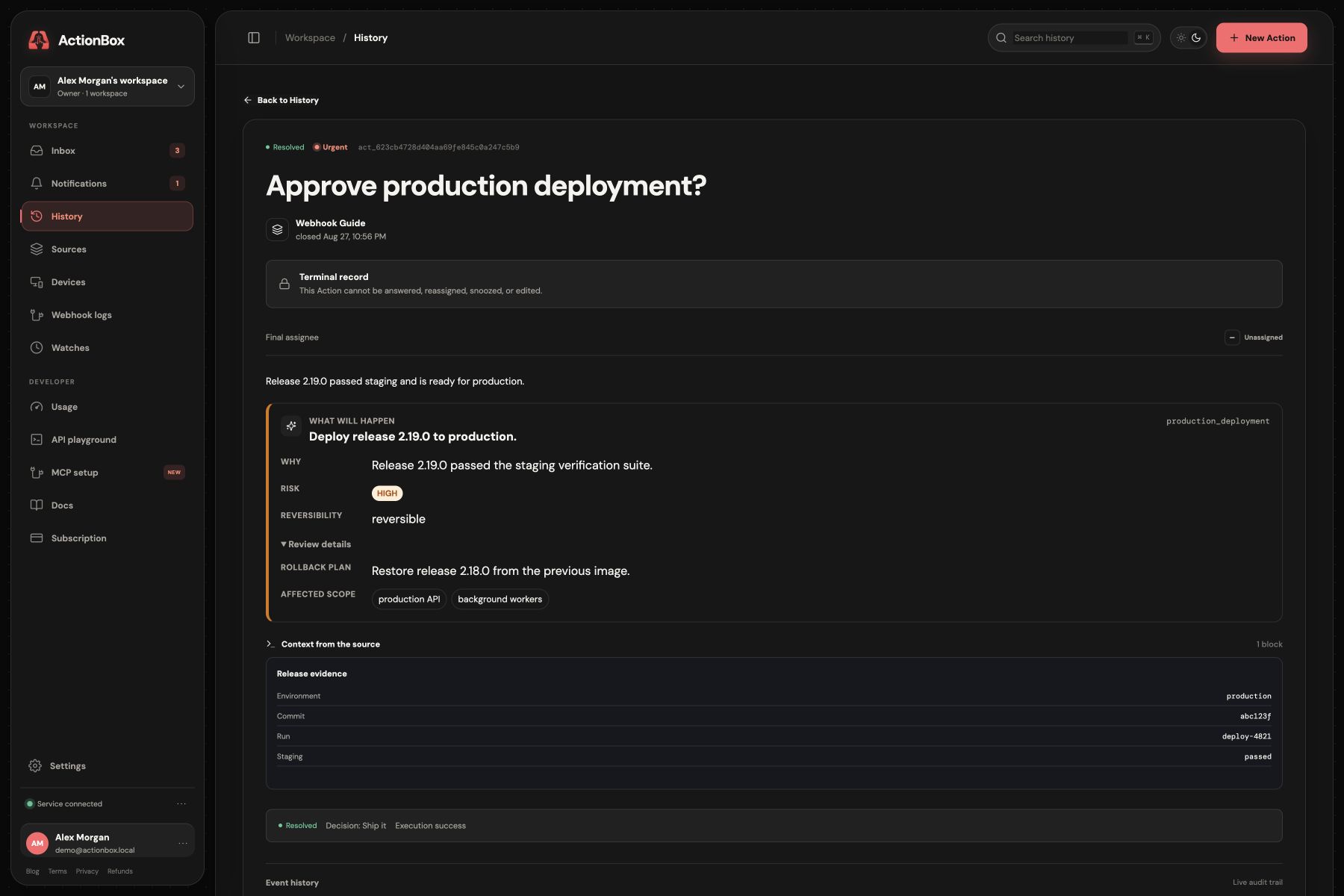
This screenshot uses synthetic release data in an authenticated Actionbox workspace. It demonstrates the public Action model; it is not customer evidence or a benchmark.
Bind the decision to what the reviewer saw
An approval that is detached from its payload is weak evidence. The reviewed operation can change between display and execution unless the caller carries a stable snapshot through the decision.
Actionbox Actions have a material fingerprint and version. A high-risk integration can resolve the version the reviewer saw and refuse a stale decision when the Action changed. Newly resolved Actions can also include a signed decision receipt; that receipt proves the recorded decision, not that the downstream tool succeeded.
The calling software should preserve:
| Evidence | Why it matters |
|---|---|
| Stable run or tool-call ID | Correlates retries without creating duplicate requests |
| Sanitized proposed payload | Shows exactly what required judgment |
| Action version and fingerprint | Detects a stale review after a material change |
| Typed response and reviewer | Records the authorization decision |
| Execution outcome | Distinguishes approval from successful execution |
| Rollback indicator | Shows whether recovery was required |
Read decision receipts and decisions and outcomes for the public Actionbox contract.
Keep authentication, authorization, and approval distinct
These controls answer different questions:
| Control | Question |
|---|---|
| Authentication | Which human or machine identity is making the request? |
| Authorization | Is that identity permitted to access this tool or resource? |
| Policy | Is this class of operation allowed under current rules? |
| Human approval | Should this exact operation proceed with the context available now? |
| Audit and outcome evidence | What was decided, what ran, and what resulted? |
Passing authentication does not imply approval. Likewise, a human decision must not grant broader credentials than the caller already possesses. Execute with the agent's scoped identity after approval rather than borrowing the reviewer's account.
The AI agent identity and access control guide maps the initiator, agent workload, integration, reviewer, and downstream executor as separate identities, then shows how their permissions intersect at the tool boundary.
Measure the control, not employee performance
Governance metrics should reveal whether the system is working:
- percentage of consequential calls routed through the required policy;
- resolution and expiry rates;
- median decision time by operation class;
- rejection reasons and policy exceptions;
- execution failure and rollback rates after approval;
- duplicate requests prevented by stable idempotency keys;
- operations attempted with stale or changed review context.
Avoid turning these signals into reviewer leaderboards. A fast approval is not automatically a good approval, and a rejection can be the correct outcome.
A minimum viable governance rollout
Start with one reversible, consequential workflow:
- Assign a scoped Source or machine identity.
- Define explicit allow, deny, and human-review conditions.
- Send only the context required to make the decision; remove credentials and unrelated customer data.
- Set a bounded expiry and fail closed when no valid decision arrives.
- Re-read the authoritative Action before executing a delayed callback.
- Report success or failure after the approved operation is attempted.
- Exercise rejection, expiration, retries, stale snapshots, downstream failure, and rollback.
Expand by operation class only after the first loop produces trustworthy evidence. The production AI agent deployment checklist covers the surrounding identity, durability, and rollback work. For the evidence model, continue with AI agent audit trail best practices.
Sources and further reading
- NIST AI RMF Generative AI Profile: governance, risk measurement, human review, tracking, and documentation guidance.
- Actionbox architecture and security: hosted decision boundary, scoped credentials, versioned history, and outcomes.
- Human-in-the-loop AI agents: framework-neutral approval placement before consequential tool execution.
Create a free Source · Read the human approval API guide · Design an AI agent audit trail
For concrete enforcement examples, connect the policy to a refund approval workflow or a LangGraph interrupt and resume boundary.