

AI agent observability should explain what the model generated, what the agent attempted, what a person authorized, what the tool executed, and whether the operation succeeded. A trace that stops at "tool call requested" leaves the most consequential part of the workflow invisible.
Actionbox is not a general tracing backend. It contributes a durable human-decision record that can be correlated with OpenTelemetry, application logs, and provider traces. Keep those systems connected by stable identifiers while preserving their separate responsibilities.
If you are choosing which operations should pause for approval and which can run under monitoring, the human-in-the-loop vs human-on-the-loop comparison sets out the control and response-time differences. This guide focuses on the evidence each path leaves behind.
Observe the complete agent action lifecycle
Each system answers a different diagnostic question:
| System | Best evidence |
|---|---|
| Agent framework | Model messages, tool selection, run state, retries |
| OpenTelemetry or tracing backend | Spans, latency, errors, token and tool-call telemetry |
| Actionbox | Human request, reviewed snapshot, typed decision, expiry, event history |
| Tool or application | Authoritative side effect and execution result |
Do not force all of this evidence into one oversized log event. Correlate smaller authoritative records.
Use stable correlation fields
Choose identifiers before adding dashboards. A useful event envelope might look like this:
{
  "trace_id": "4e4d8f...",
  "agent_run_id": "run_20260829_0142",
  "tool_call_id": "call_8d91",
  "action_id": "act_...",
  "action_version": 3,
  "operation": "deployment.promote",
  "environment": "production",
  "decision_status": "resolved",
  "execution_status": "success"
}
This is an application observability envelope, not a request to send trace IDs or unrestricted metadata to every service. Keep sensitive payloads in the system that is authorized to hold them. Use the Actionbox context only for the bounded information a reviewer needs.
Trace the proposal, decision, and outcome separately
Three events are commonly collapsed into one:
- Proposal: the agent asks to call a tool with specific arguments.
- Decision: policy or a person authorizes or rejects that proposal.
- Outcome: the calling application attempts the operation and records success or failure.
An approval is not execution success. The process can fail after a valid decision because of a provider outage, stale deployment state, rejected credentials, or an application error. Conversely, a tool succeeding does not prove that the required approval occurred.
Actionbox records the human decision and can accept one immutable execution outcome for the exact resolved Action snapshot. Your trace backend should link to that record by ID rather than copying private decision context into span attributes.
Worked example: close the evidence chain
Suppose a reviewer approves a production deployment. The worker re-reads the terminal Action, verifies that the expected decision was recorded, performs the exact approved operation, and then reports the real result. The outcome request carries the action_version and fingerprint from that resolved snapshot:
jq -n \
  --arg fingerprint "$ACTION_FINGERPRINT" \
  --argjson version "$ACTION_VERSION" \
  '{
    status: "success",
    duration_ms: 48312,
    rollback: false,
    action_version: $version,
    fingerprint: $fingerprint
  }' \
| curl --fail-with-body --request POST \
    "https://api.actionbox.cloud/v1/actions/$ACTION_ID/outcome" \
    --header "Authorization: Bearer $ACTIONBOX_SOURCE_KEY" \
    --header "Idempotency-Key: outcome:$ACTION_ID" \
    --header "Content-Type: application/json" \
    --data @-
If the tool fails, report failed with a bounded reason_code; do not rewrite the approval as a rejection. Exact outcome retries are idempotent, while a conflicting second outcome is rejected.
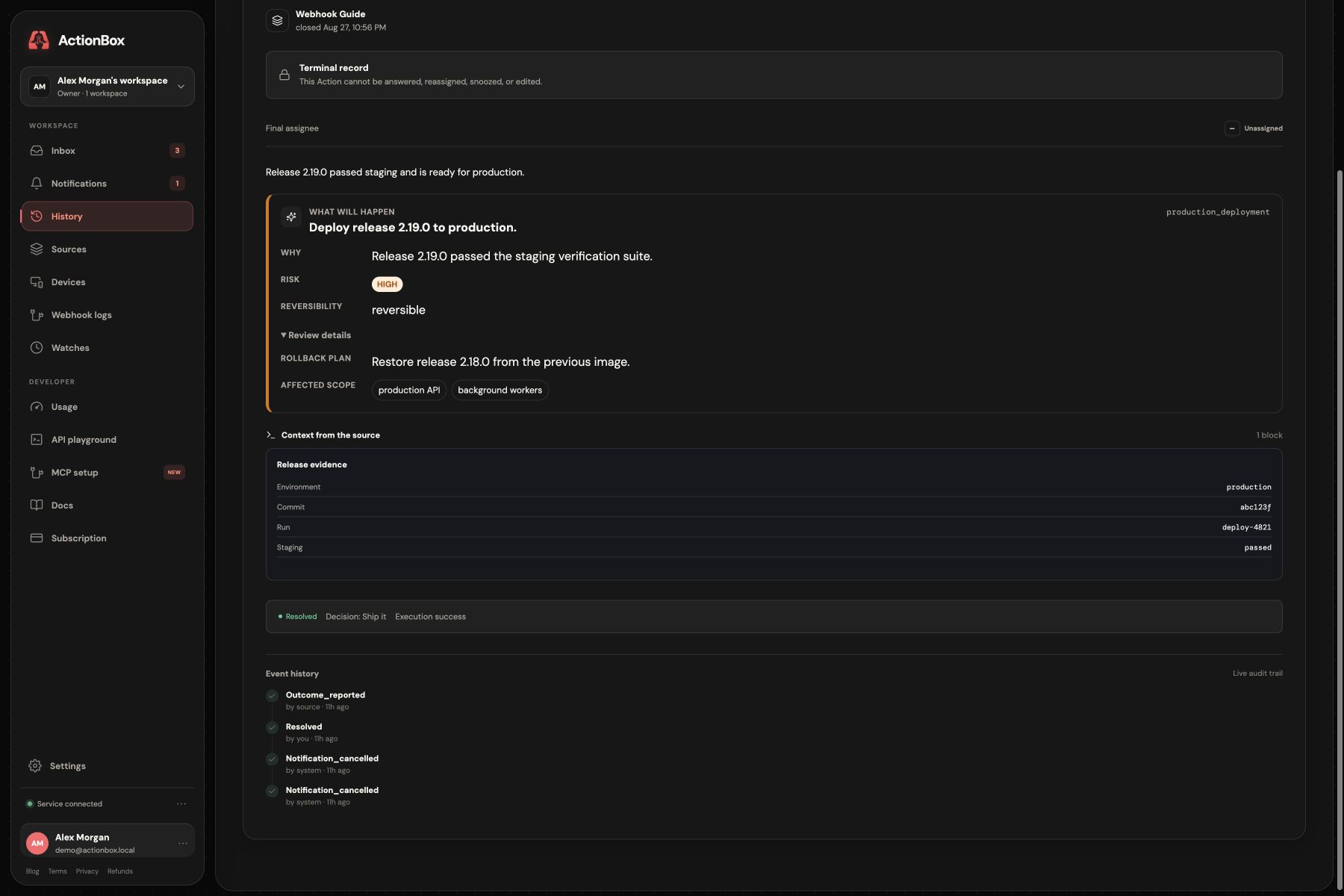
The screenshot contains synthetic deployment data. It shows the product evidence model, not a claim that Actionbox replaces application traces or proves a downstream side effect independently.
What to measure
Begin with signals that answer operational questions:
- Agent latency: model, planning, and tool-selection time.
- Human wait time: time from Action creation to resolution or expiry.
- Execution latency: time spent in the real side-effecting tool.
- Decision distribution: approvals, rejections, cancellations, and expirations by operation class.
- Outcome coverage: resolved Actions that later receive a success or failure outcome.
- Post-approval failure rate: approved operations that fail during execution.
- Rollback rate: operations that require recovery after execution.
- Retry and duplication: repeated proposals sharing the same stable machine identity.
These metrics reveal different bottlenecks. A long end-to-end duration might be model latency, reviewer wait, or a slow tool. A single aggregate timer cannot tell you which boundary failed.
Protect sensitive telemetry
Agent traces can contain prompts, tool arguments, customer data, credentials, and model outputs. Approval context can contain similarly sensitive operational details. Apply least collection rather than sending every payload everywhere.
- Redact secrets before a trace or Action is created.
- Prefer tool name, risk class, and stable hashes over full arguments in metrics.
- Keep raw content opt-in and access-controlled.
- Do not put Source keys or callback secrets in span attributes, logs, URLs, or error messages.
- Use bounded labels; never use free-form customer content as a metric tag.
- Define retention separately for traces, decisions, and application records.
OpenTelemetry's generative-AI conventions provide a common vocabulary for model and agent telemetry. They do not remove the need to decide whether recording prompts, completions, or tool content is appropriate for your environment.
Diagnose common failure patterns
| Symptom | Evidence to inspect |
|---|---|
| Duplicate reviewer requests | Tool-call identity and Action idempotency key |
| Approval arrives but nothing runs | Terminal Action, worker state, and tool execution span |
| Tool runs after context changed | Action version, fingerprint, and authoritative re-read |
| Many requests expire | Routing, notification delivery, expiry policy, and review capacity |
| Approved operations frequently fail | Tool errors, dependency health, and post-decision outcome records |
| Trace says success but audit is incomplete | Missing decision correlation or missing execution outcome |
The AI agent audit trail guide explains which evidence should remain reviewable after traces age out. The AI agent governance guide explains which operations should enter the approval path in the first place.
A practical implementation sequence
- Instrument model and tool boundaries with your tracing system.
- Define one stable run ID and tool-call ID across retries.
- Create an Action only when policy requires human judgment.
- Correlate the returned Action ID without copying private context into telemetry.
- Resume only from a valid terminal decision for the current snapshot.
- Record the actual tool result and report the Action outcome.
- Build dashboards from bounded operation classes, statuses, and durations.
- Test rejection, expiry, duplicate delivery, worker restart, tool failure, and rollback.
Sources and further reading
- OpenTelemetry: AI agent observability standards and practices: evolving semantic conventions for agent applications and frameworks.
- OpenTelemetry GenAI observability walkthrough: traces, metrics, and GenAI semantic attributes.
- Actionbox decisions and outcomes: version-bound decisions and separate execution outcomes.
- Actionbox API reference: exact resolve, decision, and outcome request contracts.
Create a free Source · Read the Actionbox architecture · Build the governance boundary